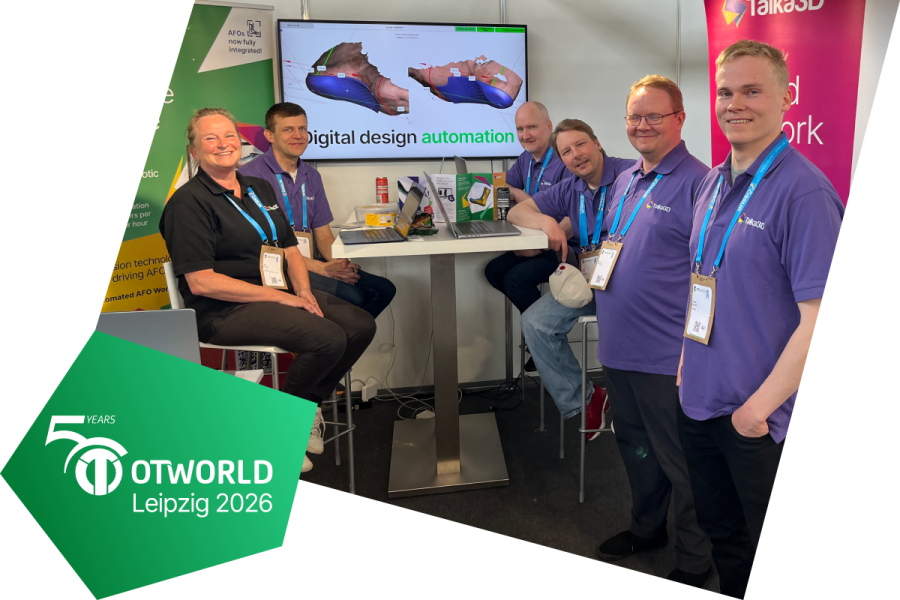
A couple of weeks on from OTWorld, after reflecting on the many conversations, demos and discussions we had, one thing feels unmistakable: the orthotics industry is moving fast – and the shift toward more digital, scalable workflows is accelerating.
For Taika3D, OTWorld wasn’t just about showcasing technology. It was about listening. Spending time with orthotists, manufacturers, clinics and innovation teams gave us an invaluable opportunity to better understand the challenges organisations are facing, and where the biggest opportunities lie.
And across dozens of conversations, some clear themes emerged.
The appetite for automation is real
Perhaps the strongest signal we saw was the growing demand for smarter, more scalable workflows.
Again and again, we spoke with organisations looking to reduce reliance on highly manual design processes and move toward more automated ways of working – particularly when it comes to custom foot orthotics and ankle-foot orthoses.
Many teams echoed the same frustrations – lengthy manual workflows, capacity constraints, and the challenge of scaling specialist expertise. All while facing mounting pressure to improve turnaround times without compromising on quality or customisation.
The question was rarely “Should we digitise?” Instead, it had become, “How quickly can we implement something that works?” That shift in mindset felt significant.
The move from manual to digital is accelerating
What became particularly clear at OTWorld is that many organisations are well advanced in their digital journey. The conversation has shifted from adoption to optimisation – connecting workflows, reducing manual steps and improving scalability
We met teams already using scanners, CAD software and 3D printers – clear signs of a market embracing digital tools. But many are now recognising the next challenge: connecting those capabilities into smoother, more scalable workflows. Manual design adjustments and fragmented processes are still creating bottlenecks and barriers to growth, shifting the focus toward smarter, more connected ways of working. At Taika3D, that’s exactly the challenge we’re focused on solving.
AFOs are a major opportunity
One of the clearest signals from our conversations was the strong level of interest around AFO workflows.
We had multiple discussions with manufacturers and specialists actively looking for ways to modernise how AFOs are designed and produced – particularly around reducing manual modelling time and improving repeatability.
There was strong interest in features that could simplify day-to-day AFO design and production, including easier shape adaptation, design automation, faster production preparation, greater consistency across devices, and more intuitive adjustments for fit and usability.
It reinforced something we’ve believed for a while: there is huge untapped potential to bring greater efficiency and scalability into AFO production.
3D printing is maturing fast
The conversation around 3D printing has clearly evolved – from possibility to practicality. We met organisations already producing custom devices using additive manufacturing, with many more exploring how to scale it. The focus now is on streamlining workflows, reducing bottlenecks and making custom manufacturing more repeatable and efficient.
For those not yet printing, ambitions are equally high — with studios investing in increasingly sophisticated carvers and robotic systems to elevate their digital carving processes.
Either way, the direction is clear: the market is ready for connected digital workflows.
Partnerships will shape what comes next
One of the most energising parts of OTWorld was the number of conversations around collaboration.
We saw growing interest from hardware providers, scanning specialists and manufacturers looking to combine strengths rather than work in silos. It’s increasingly clear that the future of orthotics won’t be built by one technology alone – but by ecosystems that work together seamlessly.
That’s exciting for us at Taika3D because helping organisations simplify complex workflows and scale digital orthotic care is at the heart of what we do.
Looking ahead
If we had to summarise OTWorld in one sentence, it would be this: The orthotics industry is moving faster than ever toward more digital, scalable and connected ways of working.
Two weeks on, we’re still energised by the conversations we had and the challenges shared so openly with us.
The appetite for innovation is clear. The willingness to embrace new ways of working is growing. And the opportunity to improve efficiency, consistency and outcomes across the industry feels bigger than ever.
To everyone who stopped by, shared feedback, challenged our thinking or explored ideas with us — thank you.
We’re excited for what comes next.